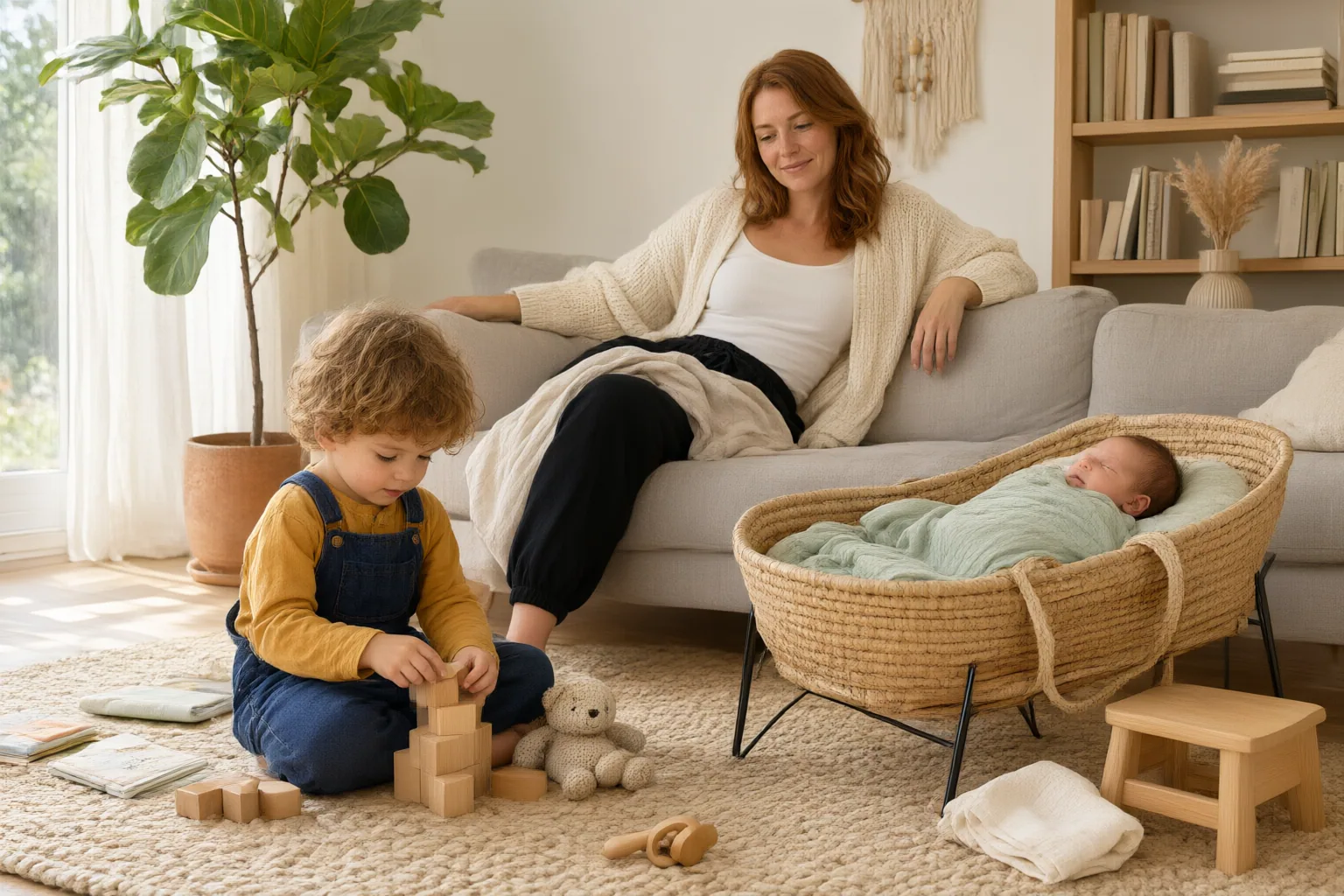
Prepare for adjustment, not a guaranteed bond. Make room for jealousy and other difficult feelings, observe how your child responds, and offer manageable ways to participate with support. Welcoming a baby and developing sibling closeness are different processes, and the supplied sources establish no timetable for either.
Make Room for Mixed Feelings About the New Baby
A child does not have to feel only excitement to begin accepting a newborn sibling. A supplied description of Lisa Miller’s *Understanding Your Two-Year-Old* identifies jealousy and other difficult feelings as issues parents may help a young child express or resolve while the child learns to accept and welcome a new baby.
Treat those feelings as part of an adjustment process, not as proof that the future sibling relationship is failing. A child might need support before being ready to participate, and outward enthusiasm should not be treated as the only acceptable response. Parents can keep the distinction clear: welcoming the baby into family life does not require immediate affection, and accepting the baby does not guarantee closeness on a particular schedule.
The source is a retailer’s description rather than the full book, so it supports only this narrow point. It does not establish a universal sequence, a fixed adjustment period, or an outcome that parents can promise.
Respond to the Child You See, Not a Fixed Script
Preparation should remain responsive because parent-child interaction works in both directions. The supplied reciprocal-socialization summary says children influence parents while parents influence children. Applied cautiously here, that means a parent can observe the child’s reaction and let it inform what happens next instead of expecting a preset script to produce a particular emotion.
Watch for the child’s response to conversation or shared participation. If the child engages, the parent can continue with an appropriate amount of support. If the child withdraws or shows difficult feelings, the next step can be smaller or slower. This is not about letting one reaction determine the family’s plans; it is about recognizing that the parent’s approach and the child’s behavior continually affect one another.
Responsive adjustment also keeps the goal realistic. Parents can shape opportunities and offer support, but the supplied material does not show that they can control when affection appears or determine the eventual quality of the sibling bond.

Use Scaffolding for Gradual, Shared Participation
The reciprocal-socialization source describes scaffolding as support that helps a child act more skillfully than the child could using existing abilities alone. It says this support can apply at any age and illustrates the idea through gradual, shared, turn-taking activities. This is a useful planning principle, although the source does not present it as a tested sibling-preparation program.
For a new-sibling transition, the bounded application is to choose one manageable shared activity and provide enough help for the child to take part. The parent can handle the more demanding parts, give the child a limited turn, and then adjust the amount of help in response to what the child does. Participation can remain practical and gradual; it need not be framed as evidence of love or closeness.
The level of support is therefore flexible rather than fixed. If the activity exceeds the child’s current abilities, the parent can simplify the child’s role or offer more assistance. If the child participates comfortably, the parent can share a little more of the activity. These steps create supported opportunities, not a promise that participation will produce bonding.
Conclusion
A realistic approach combines three ideas: acknowledge jealousy or other difficult feelings, notice how the child’s response affects the next parental move, and use gradual support for manageable shared participation. This separates the immediate task of adjusting to a newborn from the uncertain, longer-term development of sibling closeness.
Choose one small, age-appropriate shared activity today. Observe how your child responds, adjust the help you provide, and allow participation without requiring affection or promising a particular relationship timeline.
Disclosures and limitations
- This article was prepared with AI assistance from the supplied research package, which contains a retailer’s book description and a Wikipedia summary; their limitations are reflected in the wording.
- No product recommendation or affiliate endorsement is included.
Related reading
Sources
- Understanding Your Two-Year-Old od autorů Lisa Miller – Knihy na Google Play — play.google.com
- Reciprocal socialization – Wikipedia — en.wikipedia.org